


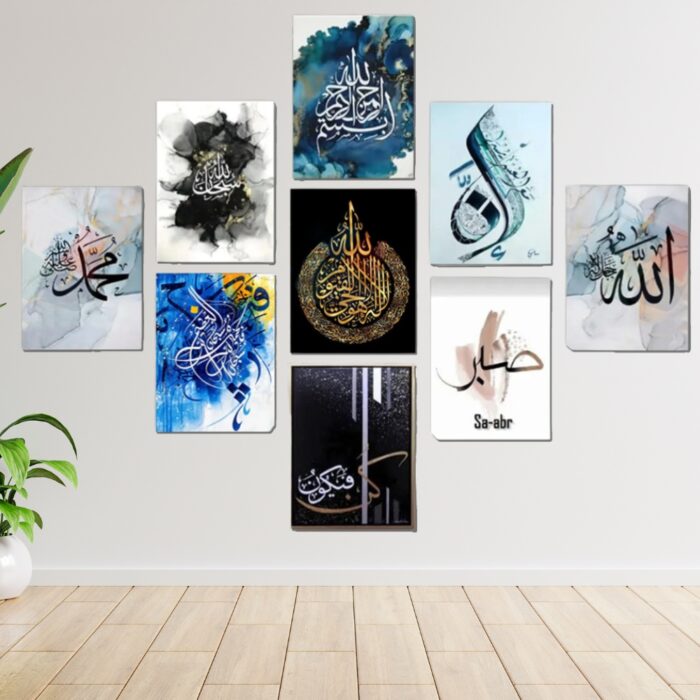
Islamic Art 9-piece Table Clock – Modern Arabic Calligraphy Design in pakistan
Islamic art is a profound reflection of the spiritual, intellectual, and cultural richness of the Islamic world. For over 1,400 years, this unique art form has captivated the world through its geometric precision, elaborate calligraphy, and symbolic designs. It transcends borders, languages, and generations — offering more than aesthetic appeal; it’s a window into the soul of Islamic civilization.
At Glazmart.com, we believe that art has the power to inspire, elevate, and connect. That’s why we proudly curate and offer a wide range of pieces inspired by Islamic art, connecting tradition with contemporary design.
What is Islamic Art?
Islamic art refers to the artistic traditions developed in the regions where Islam was a dominant cultural force. Spanning from the Middle East to North Africa, Central Asia to Spain, and parts of South Asia, Islamic art encompasses architecture, calligraphy, ceramics, textiles, metalwork, and painting.
What sets Islamic art apart is its focus on spiritual expression. Unlike Western art, which often emphasizes realism and human figures, Islamic art traditionally avoids depictions of living beings, especially in religious contexts. Instead, it embraces:
• Geometric patterns
• Calligraphy
• Arabesque designs
• Symbolic architecture
These elements reflect the harmony, order, and infinity that are core to Islamic teachin
The Origins of Islamic Art
The story of Islamic art begins in the 7th century, during the time of the Prophet Muhammad (PBUH) and the rise of the Islamic empire. As Islam spread across vast territories, it absorbed and reinterpreted artistic traditions from the Byzantine, Sassanian, Greco-Roman, and Persian worlds.
Early Islamic art was primarily focused on architecture and religious expression. The decoration of mosques, palaces, and holy books (like the Qur’an) laid the foundation for an art form deeply rooted in faith and symbolism.
One of the earliest and most iconic examples is the Dome of the Rock in Jerusalem, built in 691 CE. With its stunning mosaic work and Quranic inscriptions, it represents the essence of early Islamic aesthetics — grandeur combined with devotion.
Core Elements of Islamic Art
1. Geometry
Geometry plays a central role in Islamic art. Artists use repeating patterns and precise mathematical calculations to create symmetrical, infinite designs. These patterns symbolize unity, balance, and the infinite nature of Allah.
Geometric patterns are seen in everything from mosque ceilings to home décor — and they remain popular in modern Islamic art available at Glazmart.com.
2. Calligraphy
Arabic calligraphy is perhaps the most revered form of art in Islamic culture. It is often used to decorate mosques, manuscripts, and everyday objects. Rather than simply being written text, calligraphy in Islamic art is visual — a spiritual act of devotion.
Popular scripts include Kufic, Naskh, Diwani, and Thuluth, each with its own beauty and complexity.
The Spiritual Significance of Islamic Art
Beyond aesthetics, Islamic art serves a deeper purpose — to reflect the divine. Every element, from geometry to calligraphy, is intended to remind the viewer of the oneness of God (Tawhid).
For Muslims, creating and contemplating art is a way to connect with the Creator. The absence of human and animal figures is not a limitation but a form of respect — focusing attention on divine order and meaning.
This is why Islamic art often feels calming, balanced, and meditative. Whether you're observing a mosque dome or a calligraphy painting, the art invites reflection and peace.
ou hang a calligraphy canvas in your living room or place a geometric-patterned tray on your coffee table, Islamic art becomes a part of your daily spiritual environment.
We’re passionate about keeping the legacy of Islamic art alive — one beautiful piece at a time.
for more info: https://glazmart.com/product/islamic-art-9-piece-table-clock-in-pakistan/
Tags: #IslamicArt #ArabicCalligraphy #IslamicDecor #IslamicWallArt #IslamicDesign #IslamicArchitecture #QuranicArt #IslamicCalligraphy #MuslimArt #IslamicStyle
Islamic art is a profound reflection of the spiritual, intellectual, and cultural richness of the Islamic world. For over 1,400 years, this unique art form has captivated the world through its geometric precision, elaborate calligraphy, and symbolic designs. It transcends borders, languages, and generations — offering more than aesthetic appeal; it’s a window into the soul of Islamic civilization.
At Glazmart.com, we believe that art has the power to inspire, elevate, and connect. That’s why we proudly curate and offer a wide range of pieces inspired by Islamic art, connecting tradition with contemporary design.
What is Islamic Art?
Islamic art refers to the artistic traditions developed in the regions where Islam was a dominant cultural force. Spanning from the Middle East to North Africa, Central Asia to Spain, and parts of South Asia, Islamic art encompasses architecture, calligraphy, ceramics, textiles, metalwork, and painting.
What sets Islamic art apart is its focus on spiritual expression. Unlike Western art, which often emphasizes realism and human figures, Islamic art traditionally avoids depictions of living beings, especially in religious contexts. Instead, it embraces:
• Geometric patterns
• Calligraphy
• Arabesque designs
• Symbolic architecture
These elements reflect the harmony, order, and infinity that are core to Islamic teachin
The Origins of Islamic Art
The story of Islamic art begins in the 7th century, during the time of the Prophet Muhammad (PBUH) and the rise of the Islamic empire. As Islam spread across vast territories, it absorbed and reinterpreted artistic traditions from the Byzantine, Sassanian, Greco-Roman, and Persian worlds.
Early Islamic art was primarily focused on architecture and religious expression. The decoration of mosques, palaces, and holy books (like the Qur’an) laid the foundation for an art form deeply rooted in faith and symbolism.
One of the earliest and most iconic examples is the Dome of the Rock in Jerusalem, built in 691 CE. With its stunning mosaic work and Quranic inscriptions, it represents the essence of early Islamic aesthetics — grandeur combined with devotion.
Core Elements of Islamic Art
1. Geometry
Geometry plays a central role in Islamic art. Artists use repeating patterns and precise mathematical calculations to create symmetrical, infinite designs. These patterns symbolize unity, balance, and the infinite nature of Allah.
Geometric patterns are seen in everything from mosque ceilings to home décor — and they remain popular in modern Islamic art available at Glazmart.com.
2. Calligraphy
Arabic calligraphy is perhaps the most revered form of art in Islamic culture. It is often used to decorate mosques, manuscripts, and everyday objects. Rather than simply being written text, calligraphy in Islamic art is visual — a spiritual act of devotion.
Popular scripts include Kufic, Naskh, Diwani, and Thuluth, each with its own beauty and complexity.
The Spiritual Significance of Islamic Art
Beyond aesthetics, Islamic art serves a deeper purpose — to reflect the divine. Every element, from geometry to calligraphy, is intended to remind the viewer of the oneness of God (Tawhid).
For Muslims, creating and contemplating art is a way to connect with the Creator. The absence of human and animal figures is not a limitation but a form of respect — focusing attention on divine order and meaning.
This is why Islamic art often feels calming, balanced, and meditative. Whether you're observing a mosque dome or a calligraphy painting, the art invites reflection and peace.
ou hang a calligraphy canvas in your living room or place a geometric-patterned tray on your coffee table, Islamic art becomes a part of your daily spiritual environment.
We’re passionate about keeping the legacy of Islamic art alive — one beautiful piece at a time.
for more info: https://glazmart.com/product/islamic-art-9-piece-table-clock-in-pakistan/
Tags: #IslamicArt #ArabicCalligraphy #IslamicDecor #IslamicWallArt #IslamicDesign #IslamicArchitecture #QuranicArt #IslamicCalligraphy #MuslimArt #IslamicStyle
Islamic Art 9-piece Table Clock – Modern Arabic Calligraphy Design in pakistan
Islamic art is a profound reflection of the spiritual, intellectual, and cultural richness of the Islamic world. For over 1,400 years, this unique art form has captivated the world through its geometric precision, elaborate calligraphy, and symbolic designs. It transcends borders, languages, and generations — offering more than aesthetic appeal; it’s a window into the soul of Islamic civilization.
At Glazmart.com, we believe that art has the power to inspire, elevate, and connect. That’s why we proudly curate and offer a wide range of pieces inspired by Islamic art, connecting tradition with contemporary design.
What is Islamic Art?
Islamic art refers to the artistic traditions developed in the regions where Islam was a dominant cultural force. Spanning from the Middle East to North Africa, Central Asia to Spain, and parts of South Asia, Islamic art encompasses architecture, calligraphy, ceramics, textiles, metalwork, and painting.
What sets Islamic art apart is its focus on spiritual expression. Unlike Western art, which often emphasizes realism and human figures, Islamic art traditionally avoids depictions of living beings, especially in religious contexts. Instead, it embraces:
• Geometric patterns
• Calligraphy
• Arabesque designs
• Symbolic architecture
These elements reflect the harmony, order, and infinity that are core to Islamic teachin
The Origins of Islamic Art
The story of Islamic art begins in the 7th century, during the time of the Prophet Muhammad (PBUH) and the rise of the Islamic empire. As Islam spread across vast territories, it absorbed and reinterpreted artistic traditions from the Byzantine, Sassanian, Greco-Roman, and Persian worlds.
Early Islamic art was primarily focused on architecture and religious expression. The decoration of mosques, palaces, and holy books (like the Qur’an) laid the foundation for an art form deeply rooted in faith and symbolism.
One of the earliest and most iconic examples is the Dome of the Rock in Jerusalem, built in 691 CE. With its stunning mosaic work and Quranic inscriptions, it represents the essence of early Islamic aesthetics — grandeur combined with devotion.
Core Elements of Islamic Art
1. Geometry
Geometry plays a central role in Islamic art. Artists use repeating patterns and precise mathematical calculations to create symmetrical, infinite designs. These patterns symbolize unity, balance, and the infinite nature of Allah.
Geometric patterns are seen in everything from mosque ceilings to home décor — and they remain popular in modern Islamic art available at Glazmart.com.
2. Calligraphy
Arabic calligraphy is perhaps the most revered form of art in Islamic culture. It is often used to decorate mosques, manuscripts, and everyday objects. Rather than simply being written text, calligraphy in Islamic art is visual — a spiritual act of devotion.
Popular scripts include Kufic, Naskh, Diwani, and Thuluth, each with its own beauty and complexity.
The Spiritual Significance of Islamic Art
Beyond aesthetics, Islamic art serves a deeper purpose — to reflect the divine. Every element, from geometry to calligraphy, is intended to remind the viewer of the oneness of God (Tawhid).
For Muslims, creating and contemplating art is a way to connect with the Creator. The absence of human and animal figures is not a limitation but a form of respect — focusing attention on divine order and meaning.
This is why Islamic art often feels calming, balanced, and meditative. Whether you're observing a mosque dome or a calligraphy painting, the art invites reflection and peace.
ou hang a calligraphy canvas in your living room or place a geometric-patterned tray on your coffee table, Islamic art becomes a part of your daily spiritual environment.
We’re passionate about keeping the legacy of Islamic art alive — one beautiful piece at a time.
for more info: https://glazmart.com/product/islamic-art-9-piece-table-clock-in-pakistan/
Tags: #IslamicArt #ArabicCalligraphy #IslamicDecor #IslamicWallArt #IslamicDesign #IslamicArchitecture #QuranicArt #IslamicCalligraphy #MuslimArt #IslamicStyle
0 Comments
0 Shares
2K Views

 Arabic
 Français
 Español
 Português
 Deutsch
 Türkçe
 Dutch
Dutch
 Italiano
 Russian
 Romaian
 Portuguese (Brazil)
 Greek
Greek